

Treatments
Polynucleotides in Northampton
Patients from Kettering, Market Harborough and Northampton who've noticed their skin's quality and resilience changing — rather than just its volume — often find polynucleotides are the more targeted answer than hydration alone.
Clinic photography — treatment room or clinician, not before/after
Trusted in Northampton since 2003 — over 20 years of doctor-led aesthetic medicine.
Tissue Regeneration Through Cellular Repair
Polynucleotide therapy uses purified DNA fragments to support the skin's own repair and regeneration processes at a cellular level. Rather than adding ingredients from outside, it activates what the skin already has — encouraging damaged or depleted tissue to renew itself.
Polynucleotides are long-chain DNA fragments, purified and processed for medical use. The products used at Mulberry House are Plinest and Newest — pharmaceutical-grade polynucleotide injectables with an established clinical record in tissue regeneration.
The active component is PDRN (polydeoxyribonucleotide), derived from purified salmon DNA — a source chosen for its high biological compatibility with human tissue. When injected into the skin, PDRN is absorbed by cells and used as raw material for DNA repair and synthesis, triggering a genuine regenerative response rather than simply adding hydration or volume.
Where Polynucleotides Perform Best
Polynucleotides are particularly well suited to sun-damaged or prematurely aged skin where texture and quality have deteriorated, and to the under-eye area — one of the most delicate areas of the face, where polynucleotides can improve skin quality and fine lines without adding volume.
They are also effective for skin that feels fragile, thin or reactive and needs a gentle regenerative approach, for post-procedural recovery to support the skin after laser or peels, and for acne scarring where they support tissue repair and improve skin texture over a course of treatments.
An Honest Assessment
Polynucleotides are a more targeted treatment than Profhilo® — better suited to patients with specific repair needs than those primarily looking for hydration and glow. They are often recommended alongside or following Profhilo® for patients who want both hydration and deeper cellular repair.
They work well for patients who have noticed deterioration in skin quality, texture or density over time, those with under-eye concerns such as fine lines, crepiness or poor skin quality, and those recovering from or preparing for more intensive treatments. Treatments are delivered by Jenna Johnston and Dr John Tanqueray.
What to Expect
Polynucleotides are administered by fine needle injection into the target area. The treatment takes 20 to 30 minutes depending on the area treated. Some redness and mild swelling at injection sites is normal and typically settles within 24 to 48 hours.
Results build progressively over a course of treatments — typically three sessions two to four weeks apart to achieve the full regenerative effect, followed by maintenance as needed. Patients with significant sun damage or acne scarring may benefit from a longer initial course. For current prices, please see our Pricing page.
Who Performs This Treatment
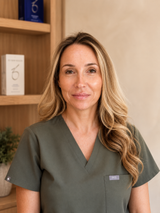
Jenna Johnston
Advanced Skin Therapist
Performs polynucleotide treatments at Mulberry House.

Dr John Tanqueray
Lead Clinician, Doctor
Performs polynucleotide treatments alongside Jenna Johnston.
Frequently Asked Questions
What exactly are polynucleotides?
They are long-chain DNA fragments, purified and processed for medical use — at Mulberry House we use Plinest and Newest, pharmaceutical-grade polynucleotide injectables. The active component, PDRN, is derived from purified salmon DNA and triggers a genuine regenerative response in the skin.
How is this different from Profhilo®?
Profhilo® is primarily a hydration and bioremodelling treatment. Polynucleotides work through cellular repair, and are better suited to patients with specific skin-quality concerns such as sun damage, thin or reactive skin, or acne scarring. The two are often used together.
Is it painful, and is there downtime?
Treatment takes 20 to 30 minutes. Some redness and mild swelling at injection sites is normal and typically settles within 24 to 48 hours — there is no significant downtime.
How many sessions will I need?
A course of three sessions, two to four weeks apart, is typically recommended to achieve the full regenerative effect, with maintenance as needed afterwards.
What People Tell Us
“The best Botox I have had in years — very clean and hygienic.”
— Jessica F.
“Always natural, leaving me looking refreshed without looking overdone.”
— Z K.
More From the Mulberry House Journal
Browse further articles and advice from the clinic in the Mulberry House Journal.
Not Sure Where to Start?
Book a consultation with our clinical team, or explore our full range of treatments — no pressure, no hard sell, just a clear sense of what will genuinely suit you.