


Skin Boosters in 2026 — A Guide to Skin Quality Treatments
Skin Boosters in 2026 — A Guide to the Treatment Redefining Skin Quality
There is a category of treatment that has quietly become one of the most requested at Mulberry House — not because of dramatic results, but precisely because of the absence of them.
No frozen features. No added volume. No obvious change that invites comment. Just skin that looks healthier, more rested and more like itself — only better.
Skin boosters have been building momentum for several years. In 2026, they are no longer a niche interest. They are a core part of how thoughtful patients approach their skin — and for good reason.
What a skin booster actually does
The name is slightly misleading. Skin boosters are not topical products. They are injectable treatments — delivered directly into the skin — that work to restore and improve its quality from within.
Most skin boosters use hyaluronic acid, a substance that occurs naturally in the skin and holds extraordinary amounts of moisture. As we age, hyaluronic acid depletes. The result is skin that appears drier, less elastic, more lined — not because of volume loss, but because of a fundamental change in its condition.
Skin booster injections address this directly. Depending on the product, they hydrate deeply, stimulate the skin's own collagen and elastin production, support cellular repair, or improve texture at a structural level. Some do several of these things simultaneously.
What they do not do — and this is important — is add volume or alter facial structure. They are not fillers. The improvements they deliver are in skin quality: radiance, smoothness, hydration and a quality of skin that catches the light differently.
For many patients, this is more meaningful than any structural change.
Why 2026 is a different conversation
A few years ago, the skin booster category in the UK was essentially synonymous with one product. Today it is a genuinely diverse field, with treatments that work through meaningfully different mechanisms — and choosing between them requires a proper clinical conversation rather than a product recommendation.
At Mulberry House, Dr John Tanqueray works with a considered selection of skin booster treatments, each chosen for a specific clinical purpose. Understanding the differences matters — not least because the right choice for one patient may be entirely wrong for another.
The treatments available at Mulberry House
Profhilo® — the benchmark
The most established skin booster in the UK, and for good reason. Profhilo® contains an exceptionally high concentration of hyaluronic acid — higher than most other products in this category — and works through a process known as bioremodelling. Rather than simply hydrating the tissue, it stimulates the surrounding skin to produce its own collagen and elastin.
Delivered via just five injection points on each side of the face, the treatment is efficient and the protocol well understood. Two sessions a month apart, followed by maintenance every six months. For patients new to this category, it remains the natural starting point.
Polynucleotides — cellular repair
The treatment that has generated the most clinical interest in recent years. Polynucleotides — available at Mulberry House as Plinest and Newest — are derived from purified salmon DNA and work at a cellular level, supporting the skin's own repair mechanisms rather than simply adding hydration.
They are particularly effective for fragile, sun-damaged or reactive skin, and in areas where other treatments struggle to work safely — most notably the under-eye. For patients whose primary concern is repair and regeneration rather than hydration, polynucleotides are often the more targeted choice.
Belotero® Revive — sustained hydration
From the trusted Belotero® family, Belotero® Revive combines hyaluronic acid with glycerol to deliver sustained hydration and improved skin texture. A natural choice for patients already familiar with Belotero® as a structural filler, and for those whose skin needs consistent moisture rather than intensive bioremodelling.
Exosomes — Purasomes™
The newest addition to the clinic's skin quality offering. Exosome therapy uses cell-signalling molecules to support skin renewal at a biological level — representing the most recent frontier of regenerative aesthetics. Discussed in full at consultation, and offered as part of a considered skin plan.
Mesotherapy
A technique rather than a single product — delivering a bespoke cocktail of hyaluronic acid, vitamins, minerals, peptides and antioxidants directly into the mid-layer of the skin. At Mulberry House, mesotherapy is used with particular focus on the delicate skin around the eyes, an area where very few treatments can work safely and effectively.
Who benefits most
Skin boosters are not for everyone — and a good clinician will tell you if they are not the right starting point for your skin.
They work best for patients who feel their skin has lost its glow, hydration or smoothness over time. For those noticing fine lines, dullness or uneven texture rather than volume loss. For patients who want to improve and maintain skin quality — either as a standalone treatment or alongside more structural work.
They are also exceptionally effective as part of a broader treatment plan. A skin booster alongside anti-wrinkle injections or dermal fillers gives the skin a quality and radiance that structural treatments alone cannot deliver. The two approaches address different things — and used together, the result is consistently more natural and more complete.
What to expect
Results from skin boosters are gradual rather than immediate. This is not a weakness — it is part of what makes them look natural. Improvement in hydration, texture and radiance typically becomes apparent over two to four weeks following the first session, and continues to develop with subsequent treatments.
Most protocols involve two to three sessions, spaced a few weeks apart, followed by maintenance at six to twelve month intervals depending on the product. Your clinician will advise on the appropriate protocol at consultation — there is no universal answer.
Downtime is minimal. Some redness and minor swelling at injection sites is normal and typically resolves within a day or two.
A note on expectations
Skin boosters are sometimes dismissed as subtle — and by the standards of more dramatic treatments, they are. But subtle and transformative are not mutually exclusive.
The patients at Mulberry House who respond most strongly to skin boosters are often those who have tried other treatments and found the results too obvious, too stiff, or simply not quite right. What skin boosters offer — skin that looks genuinely well, from the inside out — is something that no amount of filler or toxin can replicate.
It is a quieter result. For the right patient, it is the most satisfying one.
Find out more
A full overview of the skin booster treatments available at Mulberry House — including Profhilo®, Polynucleotides, Belotero® Revive, Exosomes and Mesotherapy — is available on our Skin Boosters treatment page.
To discuss your skin with Dr John Tanqueray, book a consultation at Great Addington Manor, Northamptonshire.
Call 01604 702 630
Or complete our contact form
Mulberry House Clinic
Read more

Microneedling works. But a course of six works differently. We explain the biology behind why committed treatment produces results that a single session cannot — and what the Express Collagen Boost...
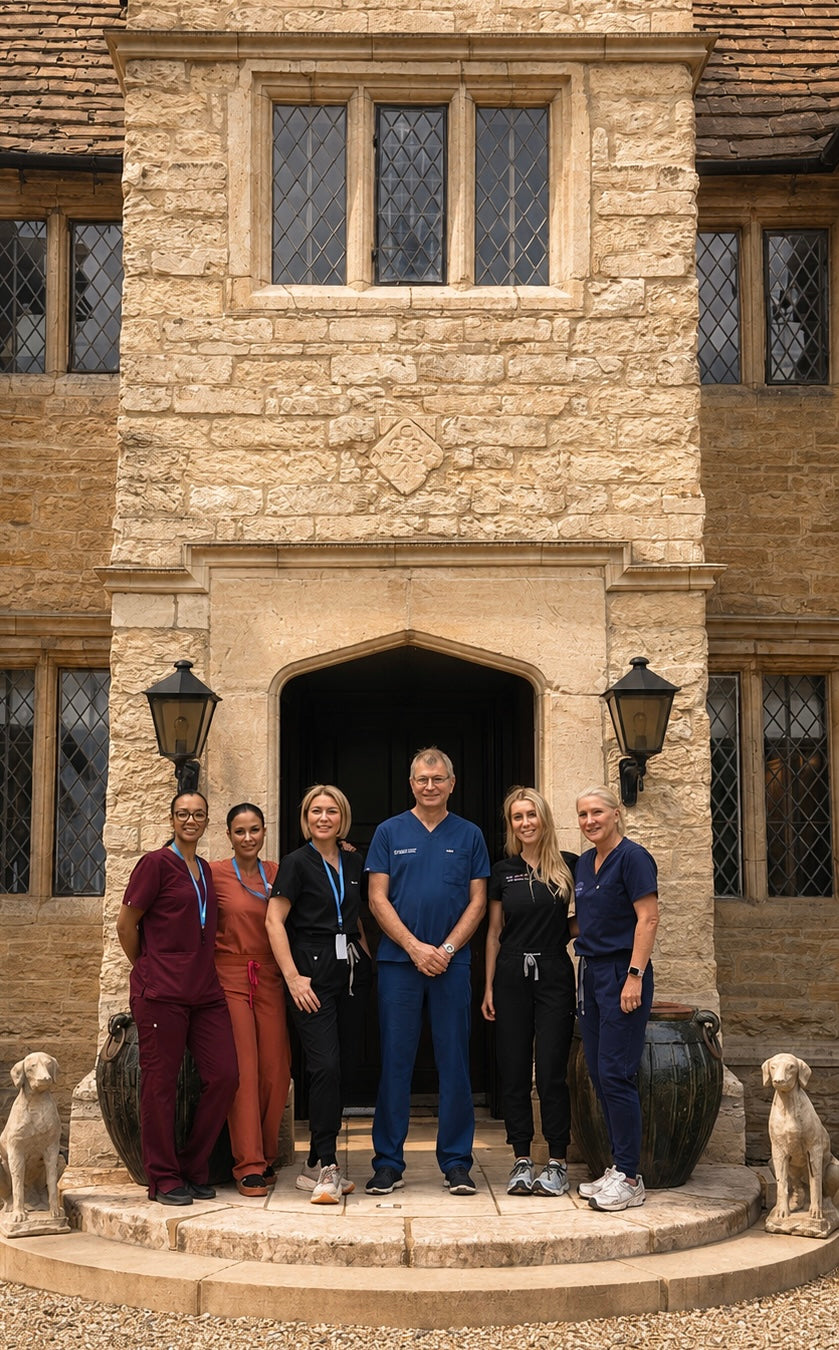
Last week we welcomed a small cohort of clinicians from across the region to Mulberry House for a Radiesse training day led by Dr John Tanqueray, national trainer. A day of expert teaching, beautif...